|
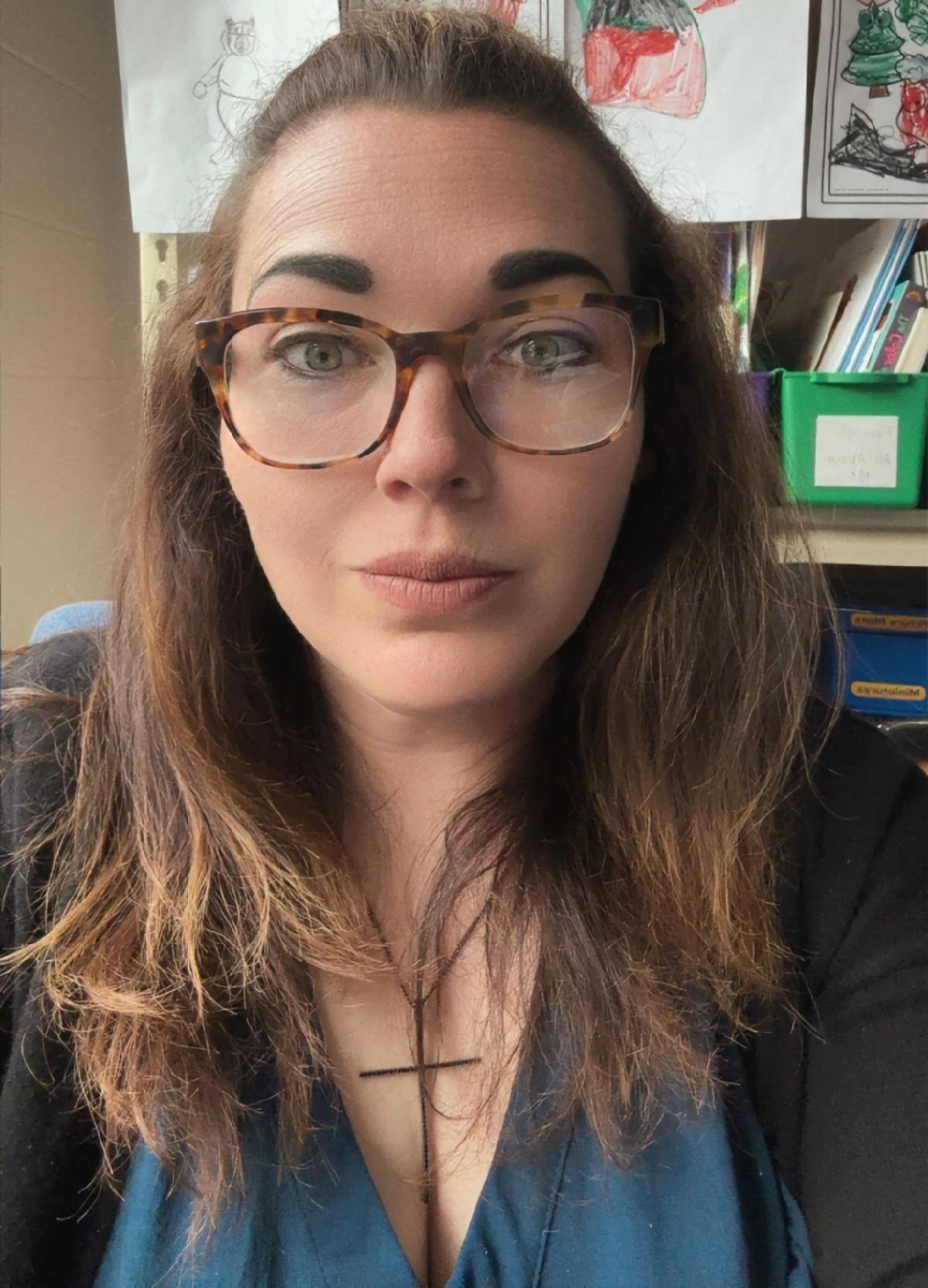
The IRC has asked members of our community to nominate Illinois teachers working with multicultural, multilingual students who are going above and beyond, and now, we’re celebrating them and highlighting their work. Keep an eye out for these features in the coming months – and if you’d like to nominate someone, email leanet@cntrmail.org. Next up is Jennamarie Lopez, a Multilingual Educator in Minooka District 201.
Says Erika Martinez, who nominated her: “Jennamarie is a compassionate and dedicated ML teacher who gives her all to her students and colleagues in her co-taught room, push-in and cotaught settings. She supports our youngest Multilingual students, ages 3 to 5, and helped them thrive and start with a strong linguistic foundation. Our data shows that her support makes a significant difference in language acquisition and the parents’ testimonies show how strong the relationships are built! Proud to have her on my team!”
In Jennamarie Lopez’s early learning class, sometimes language development starts with a seed.
In a science unit she facilitated where the classroom became a mini greenhouse, one newcomer student quickly found his voice. His family had been farmers before they moved to the United States, and he was interested in all things farming and gardening, even taking charge and teaching his peers what he knew. Students learned gardening terms in English, Spanish and Polish, and explored the scientific method as pre-K students. The student’s father even came in to give a lesson about the produce his family grew in their home country. “The student got to share what his family life was like before he came to the United States and something he was very passionate about, which was really cool,” she says.
That beautiful moment of empowerment for both the newcomer student and his family exemplifies Lopez’s approach to education. She works with three, four and five-year-olds, and her approach is centered around the whole child, learning about what motivates her students, what they like to do, what their lives look like at home, and meet the students where they’re at.
That approach extends to family engagement as well. She prioritizes personal phone calls, and asks questions like “what does a typical Sunday afternoon look like?” to understand her families’ priorities, needs and experiences, and insight into the students’ home lives. She also co-creates student language goals with the parents and caregivers. “I only have the students for a short time,” she says. “The rest of the time, they’re with their parents and caregivers. I want to make sure I have that partnership.”
Parents and families also play a role in school celebrations of different history and heritage observances, like Black History Month and Hispanic Heritage Month, and parents are encouraged to share their cultures. For example, the school hosted a family game night where families could share games they played at home or how they play a game a certain way, forming connections before students even arrived at school.
Lopez says one of her most exciting accomplishments this year has been the implementation of co-teaching in one of her school’s blended classrooms, a mix of multilingual, general education and IEP students. She and her co-teacher found ways to work together to spark student interest and build connections in the classrooms. For example, when her kids were talking about the leaves changing in the fall, Lopez and her co-teacher led the students in an activity where they built a giant fake tree out of toilet paper tubes and paper. They shook the tree to make the leaves fall and then used small rakes to clear the leaves. “Kids were raking the leaves and actively engaging with the vocabulary,” she says. “It was a very interactive, real-life experience for these kids who had never seen leaves change before.”
Working in education right now comes with a host of challenges, especially working with newcomers, who may arrive at a school in different places on their learning journey or with a variety of lived experiences. Lopez encourages her peers to be patient, to see the humanity in their newcomer students, and also to focus on the many strengths that these students and their families possess. “They have so much knowledge and so much to give,” she says. “They’re committed to learning.” |